

Quick Answer
ASTM F136 covers Ti-6Al-4V ELI, a titanium alloy containing aluminum and vanadium, while ASTM F67 covers unalloyed (commercially pure) titanium in four grades. The core difference is strength versus biocompatibility. F136 alloy delivers yield strength of approximately 795 MPa and ultimate tensile strength of 860 MPa, making it suitable for load-bearing implants like bone screws and spinal fixation . F67 Grade 4 titanium offers yield strength of roughly 485 MPa and tensile strength of 550 MPa, with superior osseointegration and a lower elastic modulus closer to human bone . Neither standard is “better”—the selection depends on whether the implant must primarily bear mechanical load or integrate with bone.
Key Takeaways
●F136 is an alloy specification; F67 is a purity specification. F136 defines wrought Ti-6Al-4V ELI with controlled aluminum (5.5–6.75%) and vanadium (3.5–4.5%) content . F67 defines four grades of unalloyed titanium, with Grade 4 being the strongest and most commonly used for implants .
●Strength gap is significant. F136 alloy provides roughly 60–80% higher tensile strength than F67 Grade 4 . This is why bone screws, spinal rods, and load-bearing components use the alloy.
●F67 Grade 4 excels at osseointegration. The absence of alloying elements and the stable TiO₂ surface layer make commercially pure titanium the reference material for dental implant bodies and other bone-contacting surfaces where integration is the priority .
●Both standards are governed by ASTM Committee F04.12 (Metallurgical Materials), and both are current: F67-24 and F136-26 are the latest editions .
●Material selection follows biomechanical function. A common design pattern uses F67 Grade 4 for the implant body (biology) and F136 alloy for the prosthetic attachment or screw (mechanics) .
The Standards: What Each One Actually Specifies
ASTM F67: Unalloyed Titanium for Surgical Implants
ASTM F67 is the standard specification for commercially pure titanium used in surgical implant applications. The current edition, F67-24, covers four grades defined by their impurity content—primarily oxygen, nitrogen, carbon, and iron .
| Grade | UNS Designation | Typical Application |
|---|---|---|
| Grade 1 | R50250 | Lowest strength, highest ductility; foil, wire |
| Grade 2 | R50400 | General implant applications |
| Grade 3 | R50550 | Intermediate strength |
| Grade 4 | R50700 | Highest strength among CP grades; dental implants, bone contact surfaces |
Grade 4 is the workhorse. Its oxygen content (maximum 0.40%) provides the highest strength within the F67 family while maintaining the biocompatibility and osseointegration characteristics that commercially pure titanium is known for .
ASTM F136: Wrought Ti-6Al-4V ELI for Surgical Implants
ASTM F136 is the standard specification for wrought annealed Ti-6Al-4V ELI (Extra Low Interstitial) alloy. The current edition, F136-26, covers strip, sheet, plate, bar, forging bar, and wire products .
The ELI designation is critical. Compared to standard Grade 5 Ti-6Al-4V, the ELI version limits oxygen to 0.13% max and iron to 0.25% max, improving ductility and fracture toughness—properties that matter for implants subjected to cyclic loading .
Mechanical Property Comparison: The Numbers That Drive Selection
| Property | ASTM F67 Grade 4 (CP Ti) | ASTM F136 (Ti-6Al-4V ELI) |
|---|---|---|
| Yield Strength (MPa) | ~485 | ~795 |
| Ultimate Tensile Strength (MPa) | ~550 | ~860 |
| Elastic Modulus (GPa) | ~105–110 | ~110–116 |
| Elongation (%) | 15 | 10 |
| Primary Strengthening Mechanism | Oxygen/nitrogen interstitial content | Aluminum and vanadium alloying |
What these numbers mean in practice:
The F136 alloy’s yield strength is roughly 64% higher than F67 Grade 4. For a bone screw that must transmit torque during insertion and then withstand cyclic loading during healing and beyond, this strength margin is not optional—it is a design requirement. The target supplier’s product page for bone screw titanium bar highlights suitability for cortical bone screws, cancellous bone screws, and locking screws, with a stated capability to customize for “better torque and high-torsion angle” —properties that depend on the alloy’s strength and the thermomechanical processing.
F67 Grade 4′s lower elastic modulus (closer to bone) reduces stress shielding—the phenomenon where a stiffer implant carries too much load and causes surrounding bone to resorb. This is why CP titanium remains preferred for implant bodies that must integrate with bone over decades .
Clinical Applications: Matching Material to Function
When F136 (Ti-6Al-4V ELI) Is the Correct Choice
●Bone screws (cortical, cancellous, locking): Require high torque strength and fatigue resistance
●Spinal rods and fixation systems: Cyclic loading demands fracture toughness
●Fracture fixation plates: Load-bearing during healing
●Prosthetic attachments and abutments: Subject to repeated masticatory forces in dental applications
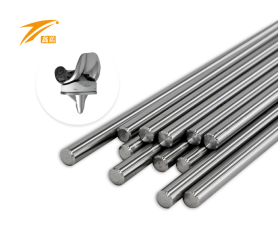
The target supplier’s bone screw product page aligns with this application profile, offering bar stock for cortical bone screws, cancellous bone screws, locking screws, and medical titanium rods.
When F67 (CP Titanium) Is the Correct Choice
●Dental implant bodies: Osseointegration is the primary requirement; mechanical load is transmitted through the abutment
●Cranial mesh: Low load, high biocompatibility requirement
●Pacemaker casings: Corrosion resistance and biocompatibility
●Porous coatings and surface structures: CP titanium’s oxide layer supports bone ingrowth
A 2026 dental industry analysis summarizes the design philosophy: “Grade 4 where biology is needed; Grade 5 ELI where mechanics is needed” .
What Buyers Must Verify When Sourcing Titanium Bar
For F136 (Alloy) Material
●ELI chemistry confirmation: Oxygen ≤0.13%, iron ≤0.25%. Standard Grade 5 with higher oxygen does not meet F136.
●Microstructure: The target supplier states its ELI bars can achieve A3 rating with tensile strength above 1100 MPa—a claim that should be supported by mill test certificates.
●Melting practice: The supplier states triple melting in German ALD furnaces—appropriate for medical-grade homogeneity.
●Flaw detection: Eddy current and ultrasonic testing for internal defects.
For F67 (CP Titanium) Material
●Grade verification: Grade 4 vs. Grade 2 or 3—each has different oxygen limits and strength.
●Interstitial content: Oxygen is the primary strengthening element in CP titanium; the certificate must show it within F67 Grade 4 limits (0.40% max).
●Surface condition: CP titanium is often supplied in descaled, pickled, or ground condition per purchaser specification .
Cross-Cutting Verification
The target supplier states ISO 9001 and ISO 13485 certification, with heat number marking from ingot through final polished bar. This traceability is essential: a mill certificate is only meaningful if the heat number on the certificate matches the bar being supplied.
FAQ
Which is stronger, ASTM F136 or ASTM F67 titanium?
ASTM F136 (Ti-6Al-4V ELI) is significantly stronger. Its yield strength is approximately 795 MPa versus roughly 485 MPa for F67 Grade 4—a difference of about 64% . This strength advantage is why F136 is specified for load-bearing implants like bone screws and spinal rods.
Can F67 titanium be used for bone screws?
Technically yes, but it is not the typical choice for load-bearing screws. F67 Grade 4 is used for applications where osseointegration and biocompatibility are primary—dental implant bodies, cranial mesh, and pacemaker casings. Bone screws that must withstand insertion torque and cyclic loading generally require the higher strength of F136 alloy .
What does “ELI” mean in ASTM F136?
ELI stands for Extra Low Interstitial. It indicates tighter limits on oxygen, nitrogen, carbon, and iron compared to standard Grade 5 Ti-6Al-4V. The lower oxygen content (0.13% max vs. 0.20%) improves ductility and fracture toughness—properties critical for implants under cyclic load .
Is ASTM F67 the same as Grade 4 titanium?
No. ASTM F67 covers four grades of unalloyed titanium—Grade 1 through Grade 4. Grade 4 is the strongest within the F67 family and the most commonly specified for implant applications, but “F67″ alone does not specify Grade 4 .
Why would a dental implant use F67 for the body and F136 for the abutment?
The implant body must integrate with bone—a biological function where CP titanium’s oxide surface and lower elastic modulus are advantageous. The abutment must withstand repeated mechanical loads—a function where F136 alloy’s higher fatigue strength is necessary. This functional split is a common design pattern in implant systems .
What certifications should a titanium bar supplier have for medical implants?
At minimum, ISO 13485 (medical device quality management) and ISO 9001. The target supplier states both. Buyers should also request mill test certificates traceable to the specific heat, and flaw detection records (eddy current/ultrasonic) for the lot being purchased.
Does the target supplier offer both F136 and F67 material?
The product pages reference titanium bar for spine screws (typically F136 ELI) and bone screws (typically F136 ELI). Buyers requiring F67 Grade 4 for implant bodies or other applications should confirm availability directly with the supplier, as the published product specifications focus on the alloy grade.
Post time: Nov-10-2026