

Quick Answer
The core difference lies in the governing standards and their acceptance criteria, not necessarily the base alloy chemistry. Both industries use Ti-6Al-4V, but medical applications require ASTM F136 (Grade 23 ELI), which strictly limits oxygen to 0.13% max and iron to 0.25% max to ensure biocompatibility and fracture toughness for implants . Aerospace applications typically specify AMS 4911 or AMS 4928, which allow higher oxygen (up to 0.20%) and prioritize high strength-to-weight ratios and fatigue resistance at temperature . A supplier’s certificate must cite the correct standard for the intended use; an aerospace-grade certificate is not a substitute for implant-grade documentation, even if the alloy is nominally the same.
Key Takeaways
- Standards define the grade, not the other way around. Medical Ti-6Al-4V is “ELI” (Extra Low Interstitial) under ASTM F136; aerospace Ti-6Al-4V is standard Grade 5 under AMS 4911/4928 .
- Oxygen content is the critical differentiator. Medical ELI limits oxygen to 0.13% for ductility and toughness; aerospace allows up to 0.20% for higher strength .
- Aerospace alloys prioritize elevated-temperature performance. Alloys like Ti-6246 are designed for compressor blades and discs with high-temperature creep strength, a requirement absent in implant design .
- Medical alloys prioritize biocompatibility and long-term stability. The ELI designation and strict interstitial control reduce the risk of adverse tissue response and fatigue failure over decades in the body .
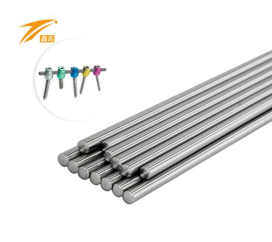
- The target URL (ASTM F136 bar) is the medical-grade specification, while Xinnuo’s aerospace pages (Ti-6246) describe a different alloy system entirely.
The Standards Divide: ASTM F136 vs. AMS 4911
Medical: ASTM F136 (Ti-6Al-4V ELI)
ASTM F136-26 is the current specification for wrought Ti-6Al-4V ELI for surgical implant applications . Its scope explicitly covers bar, sheet, plate, and wire. The “ELI” designation is the controlling feature: oxygen is capped at 0.13% and iron at 0.25% to maximize ductility and fracture toughness for implants under cyclic loading .
The target supplier’s ASTM F136 product page aligns with this specification, listing oxygen max 0.13%, iron max 0.25%, and minimum tensile strength 860 MPa for bar under 44.45 mm diameter . The supplier also states a capability to achieve >1100 MPa tensile strength with A3 microstructure and h7 tolerance—exceeding the ASTM minimums for demanding spinal applications .
Aerospace: AMS 4911 / AMS 4928 (Ti-6Al-4V Grade 5)
AMS 4911 covers sheet, strip, and plate of Ti-6Al-4V for aerospace, while AMS 4928 covers bar, forgings, and wire . The chemistry allows oxygen up to 0.20%, and the mechanical property requirements are oriented toward high strength and fatigue resistance in airframe and engine components .
The key distinction: AMS specifications do not require the “ELI” purity level. A mill certificate citing AMS 4911 confirms aerospace suitability but does not confirm implant-grade biocompatibility or fracture toughness.
| Parameter | Medical (ASTM F136) | Aerospace (AMS 4911/4928) |
|---|---|---|
| Oxygen (max) | 0.13% | 0.20% |
| Iron (max) | 0.25% | 0.30% |
| Tensile Strength (min) | 860 MPa (bar <44.45mm) | ~950 MPa (varies by form) |
| Primary Design Driver | Biocompatibility, toughness | Strength-to-weight, fatigue |
| ELI Requirement | Mandatory | Not applicable |
Sources: ASTM F136 ; AMS 4911 chemistry .
Why the Same Alloy Family Diverges
Oxygen: Strength vs. Toughness
Oxygen is a potent strengthener in titanium but reduces ductility. Aerospace designers often accept higher oxygen to maximize strength for structural components where weight is critical. Medical implant designers prioritize fracture toughness and ductility because an implant that cracks under cyclic loading is a clinical failure, not a performance trade-off. The ELI grade’s 0.13% oxygen limit is a deliberate choice for damage tolerance .
The Aerospace Alloy Extension: Ti-6246
The target supplier’s aerospace page describes Ti-6246 (Ti-6Al-2Sn-4Zr-6Mo), an alloy designed for compressor blades and discs with high-temperature creep strength and low-cycle fatigue resistance . This alloy is not used in implants. The existence of such specialized aerospace alloys underscores that “titanium alloy” is a broad category; the intended environment dictates the specification.
Traceability and Testing Differences
Medical-grade material requires heat number traceability from ingot to finished bar and third-party test reports (the target supplier cites BaoTi Test Center and Western Metal Materials) . Aerospace specifications also require traceability, but the acceptance tests (e.g., bend tests, surface contamination checks) are defined by AMS requirements, not implant standards .
What This Means for Buyers
If You Are Sourcing for Implants
Do not accept an aerospace certificate as evidence of implant grade. The certificate must explicitly cite ASTM F136 (or ISO 5832-3) and show oxygen ≤0.13%. The target supplier’s ASTM F136 page provides this documentation . If a supplier offers “Ti-6Al-4V” without specifying F136, the material may be industrial or aerospace grade and is not suitable for implant manufacturing.
If You Are Sourcing for Aerospace
Medical ELI material is generally acceptable for aerospace (it exceeds the purity requirements), but it may carry a cost premium and tighter tolerances than necessary. The reverse is not true: aerospace-grade material with oxygen up to 0.20% is not implant-grade.
The Target URL’s Role
The provided URL (/astm-f136-ti-6al-4v-eli-titanium-bar-rod-product/) is the correct medical-grade specification page. It documents the ELI chemistry and mechanical properties required for surgical implants . The supplier’s aerospace pages (Ti-6246) are separate products for different industries and should not be conflated with the medical offering.
FAQ
Is ASTM F136 titanium the same as aerospace Grade 5 titanium?
No. Both are Ti-6Al-4V, but ASTM F136 requires the ELI (Extra Low Interstitial) grade, limiting oxygen to 0.13% and iron to 0.25%. Aerospace Grade 5 (AMS 4911/4928) allows oxygen up to 0.20%. The medical grade prioritizes toughness and biocompatibility; the aerospace grade prioritizes strength .
Can I use aerospace-certified Ti-6Al-4V for a medical implant?
No. Aerospace certification (AMS 4911/4928) does not demonstrate compliance with ASTM F136′s stricter chemistry and mechanical requirements. Regulatory submissions for implants require evidence of conformance to the medical standard. Using non-ELI material introduces unnecessary risk of reduced fracture toughness.
What does “ELI” mean, and why does it matter?
ELI stands for Extra Low Interstitial. It refers to the tight limits on oxygen, nitrogen, carbon, and iron. The lower oxygen content in ELI titanium improves ductility and fracture toughness, properties critical for implants that must withstand cyclic loading without cracking .
Does the target supplier (Xinnuo) offer both medical and aerospace grades?
Yes, but on separate product pages. The ASTM F136 Ti-6Al-4V ELI bar page is for surgical implants . The Ti-6246 page is for aerospace compressor components . Buyers must specify the correct product based on their application.
What mechanical properties should the F136 certificate show?
For bar under 44.45 mm: tensile strength ≥860 MPa, yield strength ≥795 MPa, elongation ≥10%, reduction of area ≥25%, with oxygen ≤0.13% and iron ≤0.25% .
Why do some suppliers quote “Grade 23″ instead of “ASTM F136″?
Grade 23 is the UNS designation (R56401) for Ti-6Al-4V ELI. The terms are often used interchangeably, but ASTM F136 is the controlling specification for surgical implants. A certificate should cite both the grade and the standard to be unambiguous.
Is Ti-6246 used in medical implants?
No. Ti-6246 (Ti-6Al-2Sn-4Zr-6Mo) is an aerospace alloy designed for high-temperature compressor applications. It is not a surgical implant material and is not standardized under ASTM F136 or ISO 5832-3 .
Post time: Nov-10-2026